
#11: How Would You Design Your Baby?
How a Subway Ad Forced Me to Face an Uncomfortable Truth

In the subway, this advertisement got fewer looks than I did taking a photo of it.
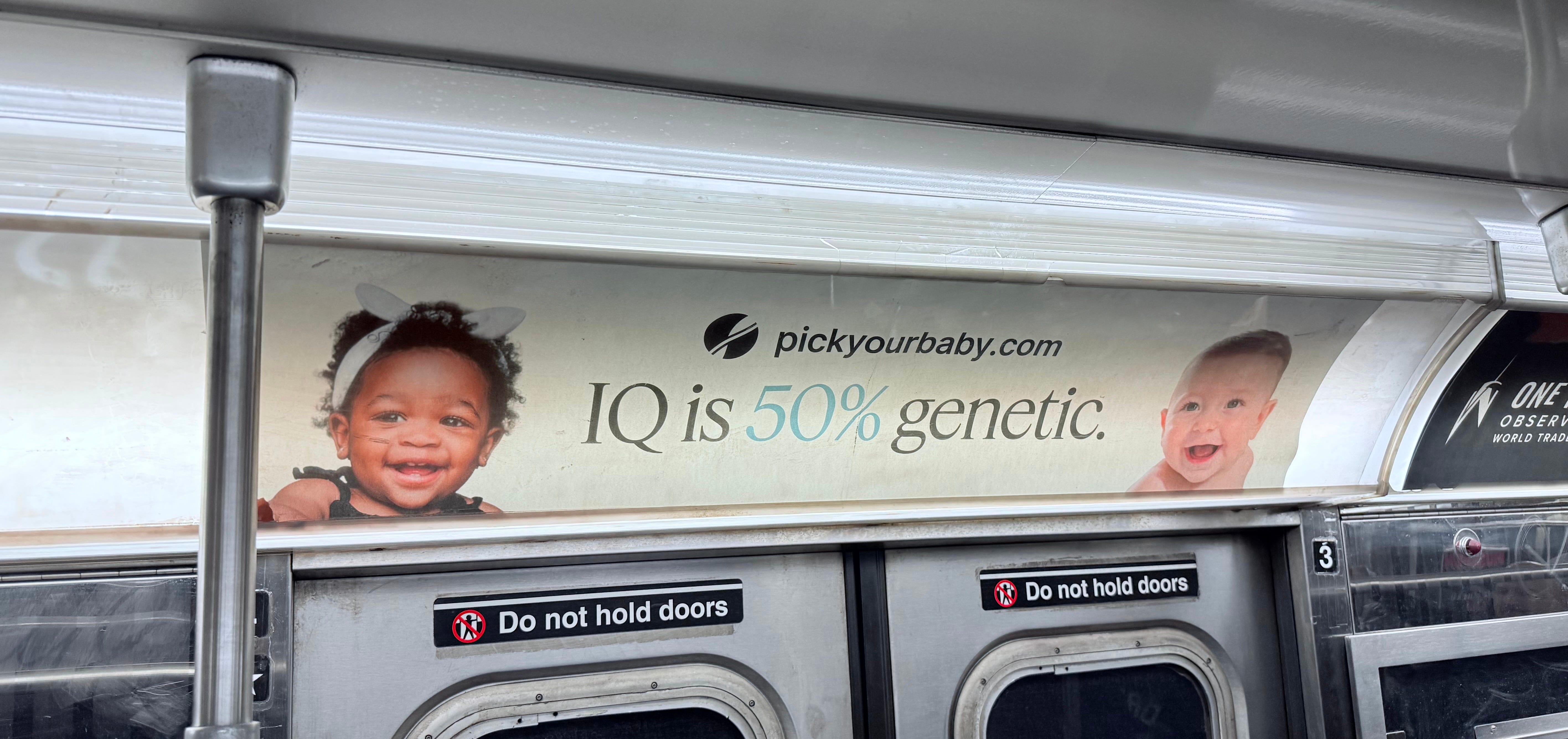
Holding a cold pole in the aisle of a train car, I was chatting with my wife.
“That’s so messed up,” I said, pointing at the abomination.
My brain only registered “IQ is 50% genetic” with a decision between a black and a white baby. Who approved this ad? They intentionally designed it to provoke someone into writing about it on the internet.
It’s such an easy jump to make this about race, but damn, I saw “guess which half of this image has a higher IQ.”
Got me! I was provoked.
I snapped the photo and wagged my finger in silent protest. Once I left the train, I googled the website. It’s just a service for in vitro fertilization, IVF, with genetic screening included, allowing you to preview risk factors and other genetic probabilities for your potential children. I have no issues with IVF, but the company positions it as shopping for the “best baby.”
For the same reason you may have clicked on this essay, the ad weaponized outrage for attention. Why was it so effective? What did my reaction reveal?
As a black person in an interracial relationship, I’m sensitive to topics on genetic preferences, especially about building a family.
Will my child be dark? Light-skinned? Will they have my nose? My wife’s eyes? Will they be as mixed and beautiful as people tell me to expect?
These are real, recurring thoughts, which undermine much of the moral high ground I asserted when ridiculing the ad. It’s easy to justify reducing risk factors and genetic complications. It’s much harder to deny my curiosity. What if the complications were cosmetic? How would my genes mix with those of my life partner?
Maybe I deserved the looks from the other passengers on the train.
Let’s reduce this to a simpler scenario. Instead of seeing all possible attributes, limit it to one. All else equal, there are two embryos to implant, a boy and a girl. This isn’t just early information, like a gender reveal; this is a choice.
Choose a boy. Or choose a girl. Predetermine the sex for a child you will bring into this world.
Years later, how do you explain it to them? Explain how and why mommy and daddy chose their sex. Ignore the morality for a moment. Logistically, what method would be most comfortable for you? We could use pragmatic arguments like, “men just have it easier in the world,” but that may perpetuate the exact biases that make life harder for women. We could use shameless arguments like, “we wanted a girl,” but then they will just ask why and we’d be back at the beginning.
Imagine scaling those explanations to cosmetic preferences like skin and hair color. How would our kids internalize that we wanted them to be more or less black, more or less Chinese? It’s impossible to make the choice decoupled from our own biases.
We could eliminate the choice itself. Pick a random number from a hat and see who pops out nine months later. Problem solved, but herein lies a humbling hypocrisy.
Now that I have the choice, don’t take it from me.
This service is targeting someone like me, a potential parent who, when given the opportunity to optimize according to my own worldview, will try to give my children the best foundation possible.
Instead of rolling the genetic dice, I’d rather sit with the discomfort of explaining to my children how I scratched at the edge of playing their God.
How do I reckon with this?
I don’t know, but for their sake, I must.

✨ Shiny Things
📚 Novel: Dept. of Speculation by Jenny Offill
This was a beautiful book, full of writing craft which I aspire to match. Deeply emotional, the structure matches form, and it tells a story through the everyday experiences that accumulate into a full portrait of a marriage and family.
🎧 Song: Dissolved Girl by Massive Attack, Sarah Jay Hawley
My Spotify Wrapped said I’m 47 and in the top 0.006% of Massive Attack fans, because I listen to Mezzanine so often. So in that honor, here is my favorite song on that album. No, I’m not that old. The 90’s just had great music.
🪞 Reflection
Alright, I don’t anticipate much agreement or consensus for this week’s essay, but I appreciate sitting in the quagmire with me. I’d love to hear any of your thoughts in the comments.
Most directly, have you encountered any existential choices that you previously thought you wouldn’t make, but have now found solace in explaining how you made them? The idea of parenthood is one that keeps putting my future self on trial.
Also, for more of my meditations on future parenthood check out:

🐦⬛ The Murder
A chance to highlight recent posts of others and help you discover more.
A really cool example of support within the Substack fiction community, where Naomi Kanakia reviews Peter Shull’s novel, Why Teach?

🪶 Before flying away
♻ If this post resonated with you, restacking it is the best way to share and show support for the publication. Don’t have the Substack app? Feel free to forward it to a friend who may enjoy.
See you next Wednesday.
Love,
Wes
If this is your first time reading Wednesday Wesdom, welcome 😀
Dive into some recent posts and personal favorites:


Well this is definitely a conversation starter! So much to focus on but for one what do you mean when you say “you must reckon with this?” The idea of building a baby to me sounds like trying to play as God and so I don’t like it. It also speaks on a desire to control things which I think is antithetical to having a kid. Parenting isn’t a video game where you create a character and dictate their path. It’s a sacred role of guardianship and guidance. I found it near impossible to ignore the morality because it is a moral proposition. Of all the available choices, abstaining from choice is the most natural and aligned to me. There is also the matter of subjectivity. Standards of beauty are subjective. There are multiple intelligences. Preemptively trying to create a life path is an extreme version of vicarious living and I think it’s unfair to all involved, especially the child.